

Vermont’s 1968 Billboard Ban: What It Aimed to Do, What It Did, and How Art Became a Workaround
Vermont’s statewide prohibition on new billboards, paired with a forced phase-out of existing ones, fell short of it's goal, and challenged what is a "sign" and what is "art."
The world Vermont was reacting to
By the middle of the 20th century, American roads had become an advertising battlefield. Businesses, knowing that signage is their #1 advertising tool, fought and clawed for larger and more impactful advertising signage. As car travel surged, roadside billboards turned into a low-friction way to get move visibility of your brand. Vermont saw billboards as an eyesore (some would argue they were ignoring the real eyesores: traffic poles, electrical utility lines, crooked light poles, telephone lines, etc.) so they moved to do what government does best, ban it!
What made Vermont’s situation politically distinctive was not just the aesthetic argument ("they’re ugly"), but a set of intertwined claims:
- Beauty was an economic asset. Vermont’s scenery was framed as something that helped attract visitors, residents, and investment.
- Billboards were seen as extraction. Opponents increasingly treated off-premise advertising as outsiders monetizing Vermont’s view for private gain.
- Safety arguments mattered. Distraction and roadside clutter were repeatedly cited, without any evidence, as public-interest concerns.
That framing became the runway for a policy that, at the time, looked radical: rather than merely regulating billboard size and spacing, Vermont moved to eliminate off-premise billboards altogether.
What the 1968 law was supposed to do
Vermont’s billboard ban wasn’t simply a vibes-based crackdown. It was anchored in a state-level push—backed by hearings and research—to preserve "scenic resources" as part of Vermont’s economic base. Scenic America’s case study summarizes how a 1967 legislative resolution created a committee to study outdoor advertising, and quotes the committee’s conclusion that scattered outdoor advertising was detrimental to scenic resources—and therefore to the state’s economic base.
However, a billboard ban can create an information vacuum (especially for travelers), and Vermont’s policymakers anticipated that critique. The state leaned into a "traveler information" alternatives; small, regulated, standardized signs rather than privately controlled billboards. The Vermont Natural Resources Council summarizes the same trade: billboards were banned, and in their place Vermont uses governmenttravel information signs along highway corridors to guide people to destinations located off those highways. Because, you know, government signs aren't an eyesore or a distraction ... apparently.
What it actually ended up doing
The ban is often described as "billboards are illegal in Vermont," but the real policy structure is more nuanced: it targets the kind of roadside advertising that promotes an off-site business or activity (i.e., "off-premises" advertising), while allowing other categories of signage—especially on-premises business signs and official or permitted directional signs.
So instead of passing laws against signs, they had specific sign limitations ... as if only those created safety hazards and were unsightly. Somehow on-premise signs are always immaculate and tasteful.
The unintended consequences: where the pressure shifted
Strong bans don’t eliminate incentives; they redirect them. Vermont’s policy pushed advertising pressure into channels that were either: (a) explicitly allowed, (b) ambiguously defined, or (c) technologically novel.
Pressure toward on-premises signs and local design politics
Because the billboard law "does not regulate on-premise advertising signs", communities and municipalities become the arena where signage aesthetics and scale are fought out.
That doesn’t mean Vermont has no big signs. It means the biggest fights move closer to zoning boards, planning commissions, design review, and the question of what is "compatible with the character of the surrounding area."
Pressure into loopholes: objects that are "not a sign"
This is where Vermont’s billboard ban begins to behave like a classic regulatory story. Once you define "billboard" and prohibit it, you incentivize people to build things that function like billboards while claiming they are something else: a vehicle, a structure, a sculpture, a seasonal display, a "message," or, most interestingly, a piece of art.
Artwork as a workaround: when a roadside message becomes "public art"
In 2018, one of the most famous Vermont examples of "art as workaround" appeared along Route 128 in Westford: a huge carved wooden hand giving the middle finger, mounted on a tall pole and illuminated at night. The sculpture became news precisely because it sat in a billboard-banned state, visibly communicating a message to the public.
The Boston.com reporting is unusually clear about the legal hinge: a Vermont Agency of Transportation spokesperson said that although the structure was visible from a state highway, it was outside the state right-of-way and did not meet the statutory definition of a "sign," so it could not be regulated under the Vermont billboard law. The article also notes local officials treated it as "public art."
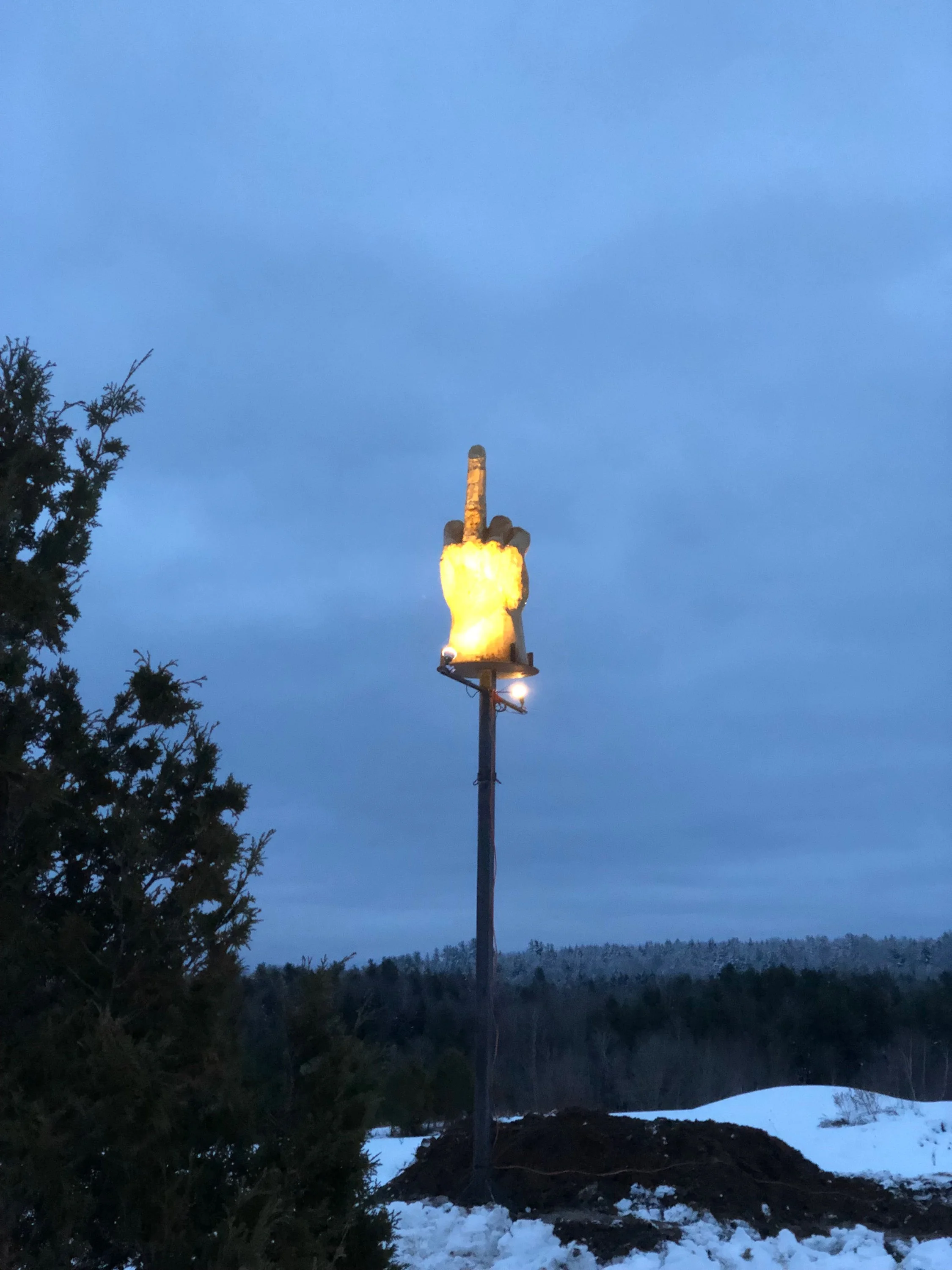
The cultural irony is almost too perfect: a law meant to reduce roadside visual aggression helped create a boundary category, "art", that can legally host an extremely aggressive gesture in full public view. And because the sculpture was framed as expression rather than advertising, it highlighted a truth that regulators everywhere wrestle with: a billboard ban is easiest to enforce when the object is obviously commercial. When the object is expressive, political, or artistic, enforcement becomes a constitutional and definitional minefield.
The next wave: "not a billboard" billboards
Vermont’s billboard ban has faced recurring challenges from clever reframing—especially when someone invents a new "container" for advertising. One recent example covered by WCAX in 2025 involves large signs mounted on hay wagons along Route 7. The business owner argued he wasn’t violating the law; state officials disagreed, pointing to the principle that Vermont prohibits signs on someone’s property for a business or activity conducted somewhere else (i.e., off-premises advertising). The same WCAX story notes specific exceptions—like official business directional signs—and offers the practical distinction that a box truck with a logo may be allowed if it’s actually transporting goods, while stationary ad displays are not.
This pattern is the modern expression of the same dynamic that made the middle-finger sculpture famous:
- Enforcement tracks definitions. If the statute regulates "signs" and "outdoor advertising," people will argue their thing is not a "sign."
- Mobility becomes a strategy. If billboards are banned, ads may show up on vehicles, trailers, wagons, or "temporary" structures.
- Art becomes a legal shelter. If something can plausibly be described as sculpture or installation, it may fall outside billboard regulation.
So what were the real ramifications?
Vermont’s billboard ban is often treated like a clean before/after: "billboards gone, problem solved." The real ramifications fall into a few buckets.
Ramification #1: The landscape became a policy asset (and a brand asset)
Whatever you think of billboard advertising as an industry, Vermont’s policy succeeded in making the roadside view feel intentional rather than auctioned. Advocates continue to frame scenic preservation as central to Vermont’s identity and economy, and the tourism numbers cited by Scenic America are often used as part of that argument.
Ramification #2: Information didn’t disappear, it got "government-ized"
The ban did not erase signage; it rechanneled it into government signage instead.
Ramification #3: The fight shifted from "ads vs. views" to "definitions vs. intent"
The moment you ban a category, the practical contest becomes semantic: Is this object a sign? Is it advertising? Is it mobile? Is it art? Boston.com’s reporting on the middle-finger sculpture is a textbook example: the state’s response hinged on statutory definition and jurisdiction, not on whether the object was "visually loud."
Ramification #4: "Art" became both a genuine cultural outlet and a loophole category
It’s important not to flatten everything into cynicism. Vermont has a real tradition of folk art, roadside whimsy, and community-scale creative expression. But the legal boundary matters: when "public art" is exempt (or simply not covered by billboard definitions), it can become a tool for people who want a big roadside message without triggering billboard enforcement.
The middle-finger sculpture is the high-voltage illustration of the point: a large roadside object carrying a message can exist legally in a billboard-banned state if it falls outside the statutory sign definition and is treated as expressive work.
The lasting lesson of the 1968 ban
Vermont’s 1968 billboard ban is often celebrated by government officials as their success eliminating billboards and commercial advertising revenue that they generate. It's a case of regulatory agencies doing what they do best, restricting things. But if it has taught us anything, it's that people are clever and they "will find a way." For businesses to succeed, they need to advertise. Since "failure" is not an option, they'll find a way.
When you remove one advertising channel, you don’t remove the desire to be seen ... you move it. In Vermont, that has meant a long-running negotiation among:
- business visibility,
- public safety and roadside clutter,
- local control and zoning politics, and
- the slippery boundary between advertising and expression.
Sometimes that negotiation ends with a quiet blue directional sign—and sometimes it ends with a giant illuminated hand giving the finger to the entire idea of being regulated.
Enjoy this article? Share it:
Share on Facebook | Share on X
If you’re evaluating vendors, working with a professional signage company can simplify planning across multiple sign types and locations.
Learn more about Signs Manufacturing, a commercial sign company
Literature
We believe we are the only sign company that offers informative literature on signage, our "Sign Buyer's Guide" series.
Our most popular Guides are:
52 Page Brochure
44 Page Brochure
40 Page Brochure
40 Page Brochure
40 Page Brochure
40 Page Brochure

Also Available
Also Available
 |
|
 |
104 Product Videos |